Friday, March 4, 2011

History of Take Back the Night


by Jessica Arriaga

The anxiety women feel when walking alone at night, the potential fear that they can radiate the body, the danger people say “they are putting themselves in,” and the fact that a women simply cannot feel safe when the sun goes down are all reasons why Take Back the Night began
According to takebackthenight.org the first Take Back the Night in the United States occurred in October of 1975 in Philadelphia. People partook in the event after Susan Alexander Speeth, a young microbiologist was stabbed and murdered while walking home alone. The first Take Back the Night to take place over seas happened in Brussels, Belgium March 4-8 in 1976. In Belgium the event was huge, two thousand women representing 40 countries attended. Both in Philadelphia and in Belgium there was a candlelit progression; these were the first documented Take Back the Night Marches
In Europe the event is called Reclaiming the Night and it started in Rome in 1976. The reported 16,ooo rapes that year are what fueled Reclaim the Night, that is a lot of women, a lot of individuals that were affected by violence. This brings me to the point that rape does not solely affect the individual but also affects so many people associated with the victim. From Rome, the event took place in Germany, on April 30 1977, which was a place where women suffered constant harassment both during the day and at night. This important movement began to grow and become acknowledged, and the next city to hold the event was Leeds, England in November of 1977. Leeds put on the event in response to many, many women being attacked, raped, and killed. These women were all prostitutes, but that was not a welcome to violence against them

Australia and India also began putting on Reclaim the Night events. Australia’s events first aimed to raise awareness against abortion and contraception. In Bombay, India after a pregnant woman was gang raped women put on a Reclaim the Night in March of 1978
In New York, the first march for women was held in 1976 and it was not until 1977 that the slogan “Take Back the Night” was brought to light by a woman named Anne Pride. In 1978 San Franciscans put on a Take Back the Night in protest to pornography, which I find interesting being that so many of us see this event used to mainly protest violence usually of a sexual nature against women. In Canada, The Canadian Association of Sexual Assault Centers declared the third Friday of September the official evening for Take Bake the Night marches nationwide
For over 30 years women have been speaking out at these Take Back the Night events attempting to combat and raise awareness of violence against women. The event seeks to eliminate all forms of sexual violence. Thousands of colleges, universities, Women’s Centers and rape crisis centers have sponsored these events all over the country, and the AS Women Center is extremely proud to be one of those organizations
Please come and join us Tuesday night for our spring Take Back the Night Event! We will be tabling both Monday and Tuesday morning. On Tuesday at 7:30pm The Women only Survivor speak out will take place and the Gender Inclusive Workshop will be going on simultaneously. We encourage women to come tell their stories, read a poem, or anything they feel comfortable sharing. The Gender Inclusive Workshop will cover bystander awareness, how we perpetuate rape culture in our society and tips on how to combat it. At 8:30 the Keynote address will be given by Kate Transchel who is a professor in the History Department on campus and has done extensive research on sex trafficking. Following the keynote will be a silent candle-lit march at 9:00pm. This event is extremely empowering and strives to promote change. So please come out and support the cause.

Planned Parenthood: Contact Your Congressperson


by Trina Walker  & Lisa Ricchio

As most people probably know by now, or at least should know, there is an amendment which has passed the House of Representatives and is on its way to the Senate, called the Pence Amendment. The Pence Amendment would strip Planned Parenthood and 102 affiliated organizations of all federal funding which includes money for contraception, cancer screening, STD testing and treating, education, family planning counseling, and much more. This Amendment would cut off 48% of Planned Parenthood patients, which is approximately 1.4 million people. Planned Parenthood and other organizations like it have provided many resources to women and men across the country for decades; I know I have personally taken advantage of the services offered, as have many of my peers. What is interesting about this amendment is that it seeks to defund Planned Parenthood because it provides abortion services to its patients. However, only 3% of Planned Parenthood services are abortions and none of the federal money Planned Parenthood receives is used for abortions. The Pence Amendment is just another attempt to push anti-choice legislation onto citizens in an effort to take away a woman’s right to choose guaranteed in 1973 under Roe v. Wade. One important step citizens can take to make sure this amendment does not pass the Senate is to contact their elected officials whether by phone call, email, or letter.


Keeping in contact with elected officials is one of the best ways people can make sure their voices are being heard and that their representatives are actually doing the will of their constituents. It is an easy process to find out contact information for Congressional members. One can easily type into Google “Congressional Directory” and find the government site which provides information on any and all Congressional members, even which elected officials represent them in the House and Senate. There is also a U.S. Capitol switchboard number to call (202) 224-3121, if constituents prefer, where one can be connected to the office of their representative and speak directly to a staff member. With all these resources available at our fingertips there is no excuse to not let our voices be heard in regards to the Pence Amendment. We need to call, write and email our representative and let them know how we feel about this outrageous attack on reproductive services. Without funding to Planned Parenthood and similar organizations, they will not be able to provide the important services which help so many women and men. We need to let our Senators know that we want them to vote NO on the Pence Amendment, and we need to contact our House members and find out how they voted on this bill, (if we don’t know already) and let them know, if we agree with that vote or not. This is the motivation behind what the AS Women’s Center is doing in its next three tabling events. We will be providing students with access to sign the pledge against this amendment, as well as showing students how to get in contact with their representatives.

If the bill passes the Senate, which is a doubtful prediction in the Democratic led Senate, it will go on to the President for signing. If he vetoes the bill it will go back to the House where it can be overruled with a 2/3 majority. We cannot afford to be silent, we need to take action.

Help Save Planned Parenthood! Contact your Lawmakers now!! 

DOMA and the Repeal Reaction


by Kate Finegold


President Obama’s policy reversal of the 1996 Defense Against Marriage Act (DOMA) last Wednesday is both “a victory” and one big step in the right direction says Dan Choi, a gay rights activist who is known for his discharge from the military under Don’t Ask, Don’t Tell.

By finding DOMA unconstitutional, the Justice Department no longer has to defend the act in federal court. This is significant, considering that there are currently two cases challenging the legality of DOMA being heard in the federal court system. Although Section 3 of DOMA still stands, laws that curb the rights of same-sex couples will now have to satisfy a higher level of scrutiny in the courts.

Put into effect during the Clinton administration, DOMA states that the federal government will not recognize same-sex marriages and that states won’t be forced to acknowledge same-sex marriages from other states. The part of the law that’s been most contested in recent court cases is Section 3, which makes unavailable federal tax returns and other federal spousal benefits to same-sex couples.


In discussing his reasons for supporting DOMA, Attorney General Eric Holder observed that the legal climate towards the issue of homosexuality has changed over the last 15 years, becoming much more progressive. Since DOMA was put into effect, laws criminalizing homosexual acts have been found unconstitutional and earlier this year Congress repealed the Don’t Ask, Don’t Tell policy. Lower courts have already for some time now been ruling that DOMA is not constitutional. Holder said that the Justice Department has for a long time now not seen the DOMA as “reasonable.”


Obama, who still does not support same-sex marriage but is open to the idea of civil unions, said that his reason for reversing the act is that it "contains numerous expressions reflecting moral disapproval of gays and lesbians and their intimate and family relationships - precisely the kind of stereotype-based thinking and animus the (Constitution's) Equal Protection Clause is designed to guard against."

Obama realizes that these laws are an unjust treatment of a minority group, calling such policies as DOMA “unnecessary and unfair.” He commented that his view on gay marriage might change as current policy towards same-sex couples also changes and becomes more egalitarian.


While the Obama administration has in the last few months made an admirable attempt to recognize that homosexuals and those of a sexual minority have rights too by reversing both DOMA and the Don’t Ask, Don’t Tell legislation, there is still a lot more to be done. While the end of DOMA is a good step forward, gay activists do have some criticism regarding how Obama went about winning the repeal. Activists including Choi say that the “the new stance would have been unequivocally historic if it were published in 2009 or 2010 as it could have then certainly fueled momentum for a full legislative repeal by a Democrat bicameral majority. It also would have saved many disappointments (including mine) if Obama and Holder used less rancid arguments about bestiality and gay inferiority in their incendiary DOJ DOMA briefs these past two years. Same goes for DADT appeals.” Yet, it is refreshing that at least the topic is finally deemed worthy of politicians’ attention, and it looks hopeful that this is just the beginning of more changes to come.

Thursday, March 3, 2011

Dolce & Gabbana: Sexualization Sells


by Maureen Ventura


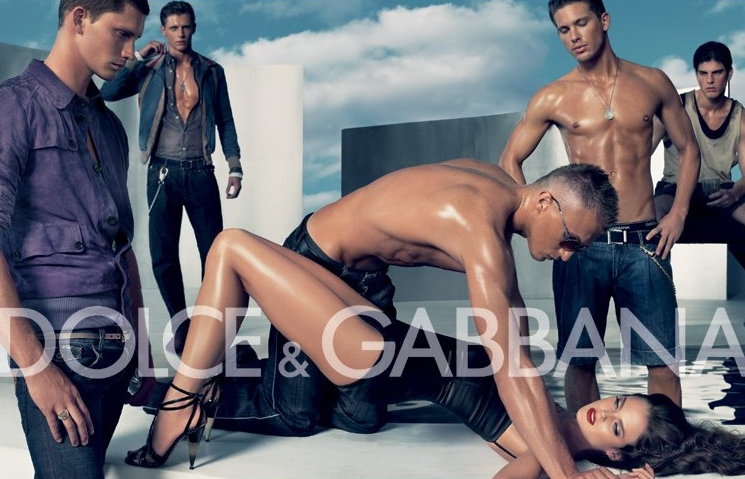
In today’s society the theory “sex sells” is more prevalent than ever.  More often sexual advertisements are seen in magazines, on television, and on billboards.  Many times these advertisements deal with women being the sex object.  One company in particular is known for their sexual advertisements, Dolce and Gabbana.  D&G degrades women in many of their ads and lowers women to be a sex object and not a human being. There has been much controversy over Dolce and Gabbana’s advertisements over the years.


Dolce and Gabbana’s 2007 advertisement raised the most controversy for them.  The advertisement shows a woman in a tight dress and stilettos looking around indicating she is in search for help.  One man who has no shirt on and is wearing sunglasses is hovering over the woman pinning her down by holding her wrists to the floor.  There are four other men in the photograph all looking down at the women.  The men are wearing either no shirt or unbuttoned shirts.  This advertisement depicts a perfect scene for a gang rape.  The woman in the photograph looks helpless and not able to control the situation.

Dolce and Gabbana’s purpose for the ad was to satisfy people’s “sexual fantasy”.  What woman’s fantasy is to be gang raped? To be sexually abused? This is an advertisement to encourage violence against women.  With the publication of advertisements like this it is setting a norm that it is normal to abuse women.  Young boys viewing this advertisement in an average magazine will see this as normal; especially when these boys are not educated that this advertisement is wrong.

Rape is far too common of an occurrence to joke around about and publish it in an advertisement.  This ad glamorizes rape and violence against women, but there is nothing glamorous or attractive about it.  This advertisement, which is true with many of Dolce and Gabbana’s ads, is seen more for the act of what is going on in it rather than the clothing in the ad.  

This advertisement was banned in Spain and Italy but that is not enough.  Dolce and Gabbana got more free publicity because of the controversy.  And their next advertisement series still included women being abused.  The women continue to be viewed as a sex object and nothing more.  People need to boycott Dolce and Gabbana to really make a statement about how offending their advertisements are towards women.  More people need to speak out about how degrading these ads are.  Women need to take a stand against Dolce and Gabbana in order for the violence to stop. 

Rape Culture in Our Day to Day Lives


by Taure Shimp


Acts of violence against women and rape are not isolated events—they take place in the context of a larger cultural system (known as rape culture) that normalizes the mistreatment of women in insidious ways. Wikipedia sums up the concept of rape culture by saying, “Within [rape culture], acts of sexism are commonly employed to validate and rationalize normative misogynistic practices; for instance, sexist jokes may be told to foster disrespect for women and an accompanying disregard for their well-being, which ultimately make their rape and abuse seem ‘acceptable.’ Examples of behaviors that typify rape culture include victim blaming and sexual objectification. In this way, sexualized violence towards women is regarded as a continuum in a society that regards women's bodies as sexually available by default.” This is profoundly problematic for obvious reasons.

One of the ways rape culture manifests itself is in “rape schedules,” which scores of women live by. Many of us find ourselves scheduling our lives around the threat of rape: a woman studying in the university library will feel pressure to leave before dark so that she can walk somewhat confidently to her car, the bus, or her bike. Joe Sharkey wrote a piece for the New York Times 
wherein business consultant Carol Margolis observed that for travelling business women, a fear of harassment “restricts some women on the road from leaving their hotels and really enjoying their travels in their off time.” Our lives are limited by the inability to move confidently through the world at all times of day.


This is why events like Take Back the Night are so important. Take Back the Night is an event consisting of workshops, speakers, and a silent march to raise awareness about violence and rape against women. Take Back the Night is, in many ways, a refusal to abide by the edicts of a rape schedule. CSU, Chico’s own Take Back the Night will be taking place on March 8, 2011. The event opens with two workshops beginning at 7:30; one is a women’s only survivor speak out where women can share their own experiences in a safe environment. The other is a workshop for both men and women. Keynote speaker Dr. Kate Transchel will address participants at 8:30 and the night culminates in a silent, candle-lit march beginning at 9:00 pm. Come be part of this empowering event!

For more information about Rape Culture (and the movements to change it), check out these links:

1.      Yes Means Yes

2.      Stop Street Harassment 

3.      Ihollaback.org 

Vagina Monologues: From an Actor's Perspective


By Lisa Ricchio


I had never seen the Vagina Monologues. I really had no idea what they were about. Besides vaginas, that is. And then one day while hanging out in the Women's Center, or better known as the Dub-C, as I often am found, someone suggested to me that I tryout for the Vmons. “You should be the moaner”, they said. Having never seen or read the monologues, but at the same time being very intrigued, I said, “Sure, why the hell not?” And I went to tryouts and read for the moaner. After tryouts, all I could think was, 'Uhhh why did they think I should be the moaner?!'


So, obviously, I got a part. A
few parts actually. I was in the introduction, the questions, the vagina workshop, and the woman who loved to make vaginas happy… aka: “The Moaner.”

The introduction was sectioned into “personalities” and then given to those of us who matched the personalities. Surprise, surprise! I was the sarcastic, dry humored character. Who would’ve thought, huh?

The questions ended up being a slide show which was a blast to make because it mostly consisted of arts and crafts. Sweet!

For the vagina workshop all I had to do was be a background person and follow the moves of “the instructor” on stage. Check.


Last but certainly not least, were the moans. As we were in rehearsals, we were doling out who would do which moan. I volunteered myself for the doggie moan, the WASP moan, and the college moan. I never thought I’d have the ovaries to get up on stage in front of 500 people in a red corset and 5 inch heels and MOAN. But hey, there’s a first time for everything, right?


Okay, so, THIS WAS THE MOST FUN EVER! My fellow cast members were awesome and really fun to hang out with 3 or 4 times a week in rehearsals and the directing duo was super patient with us. Keep an eye out next year because I’m so totally down to do it all over again!

Tuesday, March 1, 2011

Vagina Monologue Review


By Khou Xiong


I have heard that Vagina Monologues was a good show. I went to see the play expecting it to be good and it was. The word “monologue” made me think of people just talking at the audience, but it wasn't exactly that. Each monologue was interesting. I loved how most of the monologues had at least two people talking which turned it more into a dialogue, a discussion.


One of my favorite monologues had to have been “The Flood”. This piece let the audience hear an older woman's voice and ideas about her vagina through her younger, inner voice. Listening to the two difference voices really grabbed me from the start and I attention even more attention to the play. It made the performance much more interesting. This piece was about how the older woman was remembering when she went on a date with a boy. She got so excited when the boy kissed her that suddenly a “flood” came from her lady parts. She was embarrassed to ever talk about her vagina from then on and even refers to it as cellar that no one goes down to. “The Flood” made me think about all of the young women out there who have no idea about what is happening to a woman’s body when she gets aroused. The feeling of “wrongness” when one first has “the flood” happen to them is frightened and they usual ponder or wonder if what just happened to them was “wrong”.

Another thing that made this play really intriguing was the monologue “Vagina Happy Fact”. It was great that the play had true facts about a woman's vagina to let women in the audience know. Some of the facts were as follows: the Vagina has over 8,000 nerve endings, it is the only organ in the body that used simply for pleasure, and it has twice the amount of nerves than are found in the penis. I certainly didn’t know that a woman’s clitoris had twice the about of nerve endings than that of a man’s penis (particularly, the sensitive head of the penis).

I also like the monologue called The Woman Who Love To Make Vaginas Happy. It was about a woman who taught women how to moan and find their sexual center. She went through all of the different moans that one could have from religious moans (Catholic, Jewish) to college moans (“Oh professor!” or “I should be studying!”). It certainly was an experience to hear different moans. I laughed the most at this monologue because I didn’t know how funny moans could be when you heard it from others.


If you have never seen this play, I encourage you to go see it whether it's in next year's Vagina Monologues put on by the AS Women's Center or elsewhere. This play is entertaining and most of empowering.